Tuesday, April 19, 2011

Prospects

While the Orioles may not have any top-notch prospects in the upper levels of the minor leagues, it looks like Delmarva may have a number of solid talents this season. Kevin Goldstein at Baseball Prospectus wrote about Jonathan Schoop today:


Jonathan Schoop, 3B, Orioles (Low-A Delmarva): 2-for-4, HR (2), RRBI, K
"In a system very low on prospects, Schoop entered the year as the No. 6 prospect following an impressive showing in the Appy League, but he was slid from shortstop to third base (where his tools profile better) to accommodate 2010 first-round pick Manny Machado, and suddenly the Orioles have one of the more impressive left sides of an infield in Low-A. A 19-year-old native a Curacao, Schoop has good defensive fundamentals, a plus arm and burgeoning power, and is now hitting .326/.396/.605 in 11 games while become one of my better non-Top 101 sleepers of the early season."
Looks like I need to take a trip across the Bay Bridge this summer.

Monday, April 11, 2011

Outfield Defense

This is an interesting piece by Howard Megdal on outfield defense in left and right field (HT: Rob Neyer) for the New Yorks Mets, and one that may also be applicable to the Orioles. Nick Markakis has a reputation among fans and the media as being excellent defensively, but I suspect most scouts (and certainly the defensive numbers) would say he has perhaps average range and a very good arm. Felix Pie may be the opposite in left field, while Luke Scott is a bit below average on both counts.

Neyer notes that if  more balls are hit to left field than to right field (a right handed batter pull bias) then it stands to reason that left field defense would be more important than right field defense. That may well be true, but I'll suggest one more reason: left field is inherently more difficult than right field. In my experience, it is much easier to pick up the flight of a ball hit by a right handed hitter in right field than it is in left field (reverse that for left handed batters). With more right handed batters than left handers, this difference does suggest that the outfielder capable of getting better reads should play left field.

There are, of course, a few other issues that we might consider:
1) Who has a stronger arm? This is certainly important; throwing is more important in right field than in left.
2) Are there any ballpark specific factors that affect the decision? For instance, right field in Camden Yards, with its high wall, grounds crew viewing zone, and tricky corner, may be more difficult than left field.
3) How do the day's starting pitcher and opposing line-up project batted balls? Perhaps with left-hander on the mound against a right-handed heavy line-up a manager should place more emphasis on left field defense.

If Nick Markakis is one of your two corner outfielders, then it certainly makes sense to play him in right field; his arm is his most valuable defensive attribute. If, however, you're going to give Nick a day off and are trying to decide which corner should by manned by Luke Scott and which by Felix Pie, perhaps the counterintuitive but correct response would be to play Scott in right. Anyone have some data?

First Place!

The Orioles got off to a 4-0 start and are an impressive 6-3 after facing the Rays, Tigers and Rangers to open the season. The ballpark has shown signs of life, and the Orioles are the talk of the town. So why am I not more excited? Because the fundamentals don't support the hot start. To wit:

The offense (all numbers coming in to games of 4/11, league ranks in parentheses):
Team OBP: .282 (12th)
Team SLG: .348 (10th)
Team Runs: 35 (9th)
RISP: .360/.424/.720

The Orioles offense has scored more runs than its OBP and SLG would suggest because they've compensated by doing an excellent job of driving in those few runners that do reach scoring position. Based on the team-wide .243 BAbip (.400 with RISP), I would expect a bit better performance in general but with less clutchiness and for this to be a roughly league average offense.

And the pitching:
Team K/9: 6.2 (10th)
Team BB/9: 3.6 (9th)
Team HR/9: 1.1 (9th)
Team Runs Allowed: 32 (4th)

Much like the offense, the pitching is outperforming its peripheral numbers. Why? A .234 BAbip allowed. I'm willing to bet that number finishes closer to .300 than .234 (above .267). The young staff absolutely has some upside to it, but the aggregate numbers don't suggest much staff-wide improvement yet. And before you say "But the defense is much improved!," the BAbip for the 1970 O's (with Brooks, Mark Belanger, Davey Johnson, Don Buford, Merv Rettenmund and Paul Blair) was .264.

I would like nothing more than to see this O's club make a run at contention, but so far, nothing has dissuaded me that this is still a .500 team with the same odd roster construction and personnel decisions we all scratched our heads over earlier this spring.

Tuesday, March 29, 2011

Nolan Reimold Goes to Norfolk

One of this spring's most intriguing roster battles was over the 4th outfielder spot between Nolan Reimold and Felix Pie. In reality, however, the decision was a no brainer: Pie, capable of playing center field and out of options, won the job over Reimold despite Nolan's much better offensive performance this spring. Reimold's fate was likely sealed the day Vlad inked his $8mm deal to wear the black and orange, cementing Luke Scott, Derek Lee, and Vlad into the LF, 1B, and DH slots for the Opening Day roster. This has been a point of contention for many observers that would prefer to see Reimold get his everyday at-bats in Baltimore instead of Norfolk. While I agree that signing Vlad was a poor decision by the organization, I'm not especially worried that Reimold will miss out on much valuable development time in 2011, for several reasons.

First, Nolan was pretty terrible last year. He hit .207/.282/.328 in 131 MLB plate appearances and .249/.364/.374 across 401 for the Tides. Of course, his poor performance may well have been due to lingering effects from his 2009 Achilles surgery; the solid plate discipline figures and lack of power are certainly consistent with that story. He has looked better in Spring Training this year, but nothing in his performance last year suggests he should have been handed a Major League job this spring.

Next, I fear that Nolan Reimold has become a bit overrated. In 2009, he hit .279/.365/.466 in 411 MLB plate appearances, good for a 118 wRC+ (wOBA+ adjusted for league and park). Among MLB leftfielders with at least 300 plate appearances, that was good for a tie for 18th. That's a nice line and guy you're happy to have in the lineup, but the bar for being an above average hitter in left or at first base is set really high. For 2011, ZiPS has Reimold projected for a 103 wRC+, well below average for the position. Even in 2009, Reimold was good for just 1.2 WAR in 104 games, or about 1.8 per 150 games. Given his minor league numbers, a repeat of his 2009 season is probably on the slightly optimistic side of likely. At 27, there's likely not much more development left; he is what he is.

Finally, as the 2010 Orioles showed, depth is a good thing for an organization to have. What are the chances that Luke Scott (128 games in 2009, 131 games in 2010), Vladimir Guerrero (100, 152), Adam Jones (119, 149) and Derek Lee (141, 148) all avoid the DL? I'm guessing they aren't very high. What if Luke Scott really struggles against lefties (.325 career OBP)? Do I think the Orioles should have signed Vlad? No. But given the very high level of uncertainty surrounding Reimold's abilities and health, bringing in another player for LF, 1B or DH was not at all unreasonable; unfortunately, that player should have been someone eminently able to be cut or sent to Norfolk if Reimold proved his health this spring.

Still, I think that if Reimold heads to Norfolk, proves he's healthy and has rekindled his power stroke, he won't be in AAA for long. Whether it's because of an injury in Baltimore, a desire to evaluate at the MLB level, or even if he just forces the club's hand, there are plenty of at-bats to go around. Days off, platoons, injuries; for left field, first base, and DH, there will be about 2,000 plate appearances this year, and they can be filled many different ways. I wouldn't be surprised if Nolan Reimold gets four or five hundred of them.

Monday, March 28, 2011

Arbitration and Free Agency

First up, two definitions:


When is a player eligible for salary arbitration?
A player with three or more years of service, but less than six years, may file for salary arbitration. In addition, a player can be classified as a "Super Two" and be eligible for arbitration with less than three years of service. A player with at least two but less than three years of Major League service shall be eligible for salary arbitration if he has accumulated at least 86 days of service during the immediately preceding season and he ranks in the top 17 percent in total service in the class of Players who have at least two but less than three years of Major League service, however accumulated, but with at least 86 days of service accumulated during the immediately preceding season.


When is a player eligible for free agency?
A player with six or more years of Major League service who has not executed a contract for the next season is eligible to become a free agent.


In the 2011 season, there are 182 days (March 31 through September 28). For every day a player is on the active roster or disabled list, he accrues one day of service time; in any given season, a player cannot earn more than one year of service time. One full year of service is defined as 172 days, however, a player who is optioned to the minors for less than 20 days receives credit for a full year of service. This year, Day 20 is April 19. Zach Britton could pitch in Baltimore on April 20 and the Orioles would gain one extra year of club control before he is granted free agency. Since the O's are likely to control Britton's innings pretty tightly this year (he threw 153.1 last season), he'd likely be the 5th starter. Buck probably won't send his 5th starter to the mound until April 10, and then again on the 16th. The number five slot comes due again on Thursday, April 21, at which point Britton could pitch in the big leagues, having missed a mere two starts, and the O's will gain one extra season of control. I'm hoping to do the math sometime this week (been really busy), but that seems like a really great trade to me.

Tuesday, March 15, 2011

Erik Bedard

I'm super late to this, but a few weeks ago, Heath (@DempseysArmy) and I got into a bit of a Twitter spat with Matt Gardner about Erik Bedard. Short story: Matt called Bedard lazy, we said he was hurt, but awesome. Matt responded with an allegation that Bedard told O's (I think) minor league pitching coach Scott McGregor that he would throw 100 pitches or 6 innings, whichever came first. I can't find any link to this, but that, of course doesn't mean it didn't happen (Matt obviously heard this from somewhere). Setting aside whether or not he actually said this, Bedard did not face this limitation in 2006 or 2007 (the two years he was mostly healthy and largely excellent).  Those links above are to his game logs.

2006: 24 of 33 starts with more than 100 pitches, with five of 110 or more in June, July and August.
2007: 21 of 28 starts with more than 100 pitches (one with 120), including 105, 109, 112, 115, 114, 113, 104 and 116 in his final 8 starts of the season, after which he got hurt and didn't pitch again for the Orioles. In that last start, he allowed 5 walks, struck out just 3, and gave up 6 ER in only 6 innings. Was he hurt then?

Mr. Bedard certainly did not have a sterling reputation among the fans and the media; I have no idea what other players thought of him. Regardless of that reputation, though, when Bedard was healthy he took the ball and pitched. Perhaps so much for a 69-93 Orioles team in 2007 that he's thrown just 164 Major League inning since.

Friday, March 4, 2011

Five Reasons for Optimism

I'm back! Just one more class to go in my MBA career, and then maybe I'll have a bit more time to devote to the blog on a regular basis.

Matt Vensel today posted "Five reasons for Orioles optimism in 2011". Spring is obviously the season for optimism, but these are some pretty pessimistic optimistic indicators. Running through Matt's reasons:

5. A lineup without holes: This is largely true, in so much as they now have 9 position players absolutely worthy of regular at-bats in the Major Leagues. Unfortunately, it's also a lineup without much upside. Take a look through the Camden Crazies projections for this season; lots of guys with about 2.0 WAR. And now look at the ages of those regulars:

Matt Wieters, 25; Derrek Lee, 35; Brian Roberts, 33; Mark Reynolds, 27; JJ Hardy, 28; Luke Scott, 33; Adam Jones, 25; Nick Markakis, 27; Vlad Guerrero, 36.

Aside from Adam Jones (1800 career plate appearances) and Matt Wieters (900 plate appearances), no one else will play this season at an age where we can reasonably expect an improvement on their established level of performance. While I do think we'll see better numbers from Matt Wieters, Adam Jones has enough plate appearances now that it is difficult to expect big steps forward. Frankly, looking at that lineup is kind of depressing if you want the Orioles to build any sort of sustainable legitimate playoff contender.

4. Vlad the Impaler: Daniel covers this one ably. And as even Matt points out, he only hit 9 homers after the break last year.

3. The relative health of Roberts: I thought this was a post about optimism? Brian has already missed time in camp this spring with a strained neck, and the health of a balky backed 33-year old middle infielder seems much more like it belongs on a "worries" list.

2. The most interesting manager in the world: I like Buck, I really do. But if you're banking on the manager to take your club from 66 wins to the promised land, I hope your down payment on playoff tickets is refundable.

1. The young starting rotation: This is one with which I largely agree. I'm driving the Brian Matusz bandwagon, and I still harbor optimism that Chris Tillman can figure things out if only the organization will leave him alone in the Majors for a few months. I think Arrieta and Bergesen are both the type of arms that good organizations should turn out regularly, and I'm tremendously excited for Zach Britton. Guthrie isn't young, but he's still cheap and has proven to be a very valuable innings muncher.

In conclusion, this is a team that can reasonably be expected to make a run at .500, which, considering the miserableness of the past few years, is certainly a step forward but hardly anything to get excited about. The young pitching, however, really does have some upside. If there are legitimate reasons for optimism, they are on the mound.

Thursday, January 20, 2011

2011 Ticket Prices

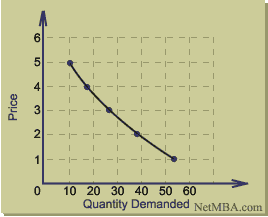
Despite setting a record low for attendance in 2010, the Orioles are raising ticket prices.


“We believe that the average increase of $3 per ticket is not going to negatively impact someone’s decision to buy, although we recognize no one ever wants to pay more for anything. We certainly understand that point,” Bader said.


Perhaps I should draw him a demand curve.

Friday, December 10, 2010

Kevin Gregg

Jeff Zrebiec at The Sun has news today that the Orioles have a 2-year, $8-$10 million offer out to former Blue Jays closer Kevin Gregg.  Jeff is wondering whether Gregg would "unseat" Koji as the closer if he signs.  Leaving aside whether or not the O's should be throwing millions of dollars at free agent relievers (they shouldn't be), having Gregg close games might not actually be a bad idea.  He's a Proven Closer (TM), though not a great pitcher (career 8.3 K/9, 3.7 BB/9), meaning that the Orioles don't really want him pitching in the highest leverage situations.  Moving Koji--and his great strikeout numbers--into potentially higher leverage situations with runners on base in the 7th and 8th, could be a better use of bullpen assets.  I don't know if this is how MacPhail is approaching the situation, but if that's how it works out, we probably shouldn't complain too much.

Wednesday, December 8, 2010

2011 Roster

At the risk of getting overly excited and jumping the gun, it appears that the O's may be getting close to trading for J.J. Hardy.  If true, the Orioles will have gone a long way toward filling out their 2011 roster.  Let's take a quick look at how things are shaping up.

CA: Matt Wieters
1B: open
2B: Brian Roberts
3B: Mark Reynolds
SS: J.J. Hardy
LF: Felix Pie
CF: Adam Jones
RF: Nick Markakis
DH: Luke Scott

B: Nolan Reimold
B: Craig Tatum
B: Jake Fox
B: open (utility IF - Robert Andino/Cesar Izturis?)

SP: Brian Matusz
SP: Jeremy Guthrie
SP: Brad Bergesen
SP: Chris Tillman
SP: Jake Arrieta

CL: Koji Uehara (rumored)
LRP: Mike Gonzalez
RRP: Jim Johnson
RRP: Jason Berken
RRP: Alfredo Simon
LRP: open
?RP: open

That leaves four open spots (assuming the O's come to terms with Koji): 1B, utility IF, another lefty for the bullpen, and one more bullpen arm.  There appear to be lots of irons in the fire for 1B (maybe Derek Lee?), and utility IF won't be tough to fill, but what to do with the bullpen?  My guess is the O's sign one of the many available righties and also bring back Mark Hendrickson.  They could also bring in another veteran starter to provide some depth, perhaps shifting Tillman or Arrieta back to Norfolk (again) or to the bullpen for the time being.  Either way, the 2011 roster looks close to being set.  Not a contender, but that looks to me like a big improvement over what was on the field for most of 2010.

Wednesday, December 1, 2010

Beer at the Ballpark

It looks like Delaware North, the new concessions company for Oriole Park at Camden Yards, is taking a food tour of Baltimore today.  The Orioles (@BirdlandInsider) and Delaware North officials (@BallparkRick) are tweeting about.  If you're a beer fan, be sure to let them know we want good craft beer at the Yard in 2011.

Monday, November 8, 2010

Adam Dunn

Blogfight!

The Orioles need a first baseman.  This is obvious.  In 2010, the six players that donned a mitt combined for an amazingly low -1.1 fWAR.  From Adam Dunn to Xavier Nady, there's a veritable alphabet soup that the Orioles could target to provide an easy three win (or more) upgrade over this year's club.

One option with which I am not enamored is Adam Dunn; certainly, I don't think the Orioles should offer 4-years and $15 million per season for him.  There are a few reasons that I think Adam Dunn is a bad choice, some recounted ably by Dave Cameron:

1) He will cost the O's their second round draft pick.
2) There are lots of other, cheaper options for first base.
3) He's been worth $15 million or more exactly once in the past six seasons.
4) His "old player" skills and body type make me think he's susceptible to rapid decline.
5) His 2010 season showed a decline in walk rate and a rise in his strikeout rate, which combined for a very large increase in his K/BB ratio.

I think it goes without saying that Dunn's value lies entirely in his bat.  At the very best, he's an average defender at first base (both Fangraphs and B-Ref have him as a -3 defender in 2010), and he's not going to provide any value on the bases (his last stolen base came in 2008).  Historically, though, his bat has been a good one, driven by prodigious power and a keen batting eye.

From 2001 to 2009 he posted an aggregate line of .249/.383/.520 built on a .292 BABIP, 26.5% strikeout rate and 16.9% walk rate (1.57 K/BB ratio).  His 2010 line, .260/.356/.536, doesn't look out of line at all with his career performance, but his ratios diverged significantly.  His BABIP rose to .329, he struck out 30.7% of the time (previous high: 28.6% in 2004), and he walked in just 11.9% of his plate appearances (previous non-rookie half-season low: 15.8% in 2003).  He had never before posted a K/BB ratio above 2.0.  This season it spiked to 2.58.  As Keith Law notes, he also saw the fewest pitches per plate appearance of his career in 2010.  His batting eye clearly regressed in 2010; how much longer will the power last?  Yes, Dunn has been durable and healthy, but that question makes me extremely hesitant to offer anything longer than a three year deal.

All told Dunn was worth about 30 batting runs last season, right in line with his average from the past six seasons.  Subtract 10 for a positional adjustment, add 20 for replacement level, and assume 0 for his defensive abilities, and Dunn is a 4.0 win player.  At $4m per win, that suggests he could get about $16m for a one year contract in 2011.  I suspect that most teams, though, aren't going to value him as an average defender (knock off $4.0m), and a long-term deal may well come with a slight discount (knock off another $1m), right in line with the Fangraphs crowdsource (which has Dunn priced at 3/$12.5m) and Dave Cameron (who guesstimates 3/$11m).

I can accept that an offer of $15m per season may be what it takes to convince Dunn to come to the American League, but, for me, 4/$15m is just too rich a deal for a 31-year old bat-only player coming off a season where he showed some early signs of aging in the weaker league.  This Orioles club isn't yet ready to contend, and if it is, it will be because the pitching takes a huge leap forward.  If that happens, by all means, trade for someone like Adam Dunn.  Right now, though, the money would be better spent targeting a cheaper option at first base and spending the balance on some more hitting prospects, including the one the O's could take in the 2nd round of a very deep 2011 draft class.  First base shouldn't require an imperfect, expensive fix.

Monday, November 1, 2010

Friday, October 29, 2010

Elias Rankings

Those antiquated, head-scratching Elias Free Agent Rankings that will drive the market for many a veteran this off-season are out over at mlbtraderumors.com, and the Orioles have two players on the list, Koji Uehara and Kevin Millwood.  Should the O's offer either of these Type B free agents arbitration?

In this discussion, it's important to remember that a Type B free offered arbitration nets the player's former club a supplemental compensation draft pick but does not cost the signing club it's own pick.  Thus, unlike Type A players who come with a cost over and above the contract dollars for which they sign (a surrendered draft pick), Type B players that are offered arbitration won't see reduced demand for their services.  With the technicalities out of the way, let's analyze the situations for both Koji and Millwood.

Koji Uehara: 2 year/$10 million contract expired
2010 stats: 44.0 IP, 11.25 K/9, 1.02 BB/9, 2.40 FIP, 2.91 xFIP, 1.4 fWAR, 1.2 bWAR
2009 stats: 66.2 IP, 6.48 K/9, 1.62 BB/9, 3.56 FIP, 4.51 xFIP, 1.7 fWAR, 1.2 bWAR

Despite pitching barely 110 innings over two seasons, Koji earned his $10 million keep, returning 2.5-3.0 WAR (depending on your methodology).  He was especially good out of the bullpen this season, proving an effective closer for the final two months of the season. Most impressive (other than his sideburns, of course)?  His walk rates.  He didn't walk a single batter after August 4, a span of 26.1 IP.  And, oh, yeah: he struck out 35 during that time. His overall numbers weren't BABIP aided, and both his FIP and xFIP back up the notion that he can be an excellent reliever.  Now, I am far from an expert on arbitration awards, but he only had 13 saves and made $5 million in 2010.  That seems like a recipe for an award in the $7-$8 million range, and I think Koji is a solid bet to worth that amount out of the 'pen.  Recommendation: Offer arbitration.  If he accepts, fine.  If you resign him and avoid arbitration, great.  If he declines, take the pick.

Kevin Millwood: 5 year/$60 million contract expired
2010 stats: 190.2 IP, 6.23 K/9, 3.07 BB/9, 4.86 FIP, 4.66 xFIP, 1.3 fWAR, 0.5 bWAR
2009 stats: 198.2 IP, 5.57 K/9, 3.22 BB/9, 4.80 FIP, 4.78 xFIP, 2.4 fWAR, 3.4 bWAR

Millwood is clearly on his last legs as a Major League starting pitcher.  He's been roughly the same pitcher since 2007, striking out a bit more than 6 batters per nine while walking about 3 per nine with an ERA fluctuating between solid and poor as his BABIP moves around the league average.  He's not a good bet to be worth more than a win (or maybe two), meaning that he'll almost assuredly be overpaid in arbitration.  He is, however, a very durable pitcher with the ability munch a lot of innings.  Plus, an arbitration award would mean just a one year commitment.

I suspect that the team would very much like to have another veteran arm to complement Guthrie and Matusz; Arrieta, Bergesen and Tillman are still wild cards in terms of their performance, and Zach Britton may or may not be ready for the big league rotation.  Thus, the question becomes whether or not the club can entice a similar pitcher to Millwood to sign in Baltimore for a lower cost (for clarity's sake, I'm working on the wild assumption that Cliff Lee isn't coming to Baltimore).  Looking at the list of free agent pitchers, filled with injury question marks and guys seeking longer-term deals, I'm not sure they can.  Recommendation: Offer arbitration, assuming an award in the $10-$12 million range.  Ideally, you'd sign a player like Millwood for about $6 million, so if he accepts, you've overpaid for stability, but haven't locked yourself into a long-term deal.  If you resign him and avoid arbitration, you've still overpaid, but haven't locked yourself into a long-term deal.  And if he declines because he doesn't want to return to Baltimore and he's willing to accept less money elsewhere, take the pick.

I realize my Millwood recommendation is both expensive and controversial.  Disagree with my conclusion?  Let  me know why.

Friday, October 15, 2010

Hitting Drill

As Daniel at Camden Crazies has been telling us for months (and as others have detailed more recently), Nick Markakis struggled to hit with any pull power this season, and that makes this article extremely interesting to me.  As the article details, "There is a core of players who regularly use Long’s drill, which teaches players to pull the ball for power."  Sounds like just the medicine he needs!  In a related story, the Orioles still haven't made any decisions about bringing back Terry Crowley for next year.

Wednesday, October 13, 2010

Shortstop

The Orioles need a shortstop.  Cesar Izturis is a free agent, and there are no viable internal options (sorry, Mr. Andino).  The Orioles could potentially resign Izturis, but his bat has deteriorated so incredibly far that even excellent defense leaves him below replacement level (-34 batting runs brought him to -0.4 fWAR in 2010).  The options on the free agent market are also extremely thin.  There is, however, one intriguing (potential) option: Hiroyuki Nakajima.  There is no guarantee that he will be posted this off season, and there are certainly questions over how well he would make the transition to MLB, but given the dearth of domestic options, this is one import the Orioles would do well to give a long, hard look.  Could signing Koji two years ago have also helped address the shortstop position?

Tuesday, September 28, 2010

Adrian Beltre

Last winter, Adrian Beltre didn't like the options he had for signing a long-term contract and instead signed a 1-year deal with the Boston Red Sox for $9 million (plus a player option he's sure to decline).  In their excellent contract crowdsourcing series, FanGraphs took up his free agent case today.  The result: 4 years/$13 million per.  At that price, the Orioles should absolutely pursue Beltre for a long-term deal.  The club has no clear cut option for anyone on the left side of the infield (if Josh Bell succeeds in 2011 I'll happily eat those words), and the club could really use a right-handed hitter capable of hitting for some pop.  No, he doesn't bring the on-base skills this club really needs, but he sure does bring the glove.  He's probably a 3-win player, making the $13 million annual value appropriate, and he would fill a much needed hole for the O's.  This would be a good signing.

Saturday, September 25, 2010

Craft Beer

The Sun website picked up a Chicago Tribune article on craft beer today, entitled "Craft beer market draws attention of big breweries".  There's nothing new in there (it could have easily been written in 2005, only without the focus on recession), but there is one epic fail: there's not a single quote from a craft brewer!  The writer quotes PR people from Diageo, Tenth & Blake (MillerCoors), and several industry publication sources, but fails to talk to anyone from the other side of the story (have you ever met a craft brewer not willing to talk?).  Sigh.

Wednesday, September 22, 2010

Alewife

Last weekend, Alewife opened about 0.4 miles north of Gate H at Camden Yards. Always on the lookout for great beer, especially within a short walk of the ballpark, I thought I better check it out.  It was well worth the trip.

As anyone who visited the building in its former incarnation as Maggie Moore's or Lucy's can attest, Alewife is an impressive bar space.  High ceilings, ample seating, beautiful stained glass windows; it's tough to imagine a better setting for a drink.  And, speaking of drink, Alewife aims to please.  The bar has 40 draft lines and, once they're fully up and running, will stock more than 100 different bottles.  If they regularly pour a draft lineup anywhere near as good as their debut efforts, though, that bottle list will be superfluous.  After much consternation, I decided to try a Jolly Pumpkin Calabaza Blanco ($8) and a Smuttynose Big A IPA ($5), both new to me.  Other options included beers from Oscar Blues, Bear Republic, Green Flash, Stone, and Victory, several Belgians, and a healthy selection of IPAs (hops seem to be the owners' Achilles heel).  I chatted with a knowledgeable bartender, Brian, who explained that the beer list will change regularly, with one or two taps changing on a daily basis that so every two to three weeks nearly the entire list will turnover, keeping the beer fresh and regulars from getting bored.  There are also plans in the works to regularly put casks on the bar, but a permanent pump system is unlikely.  As for food, I really enjoyed my Smoke Burger ($14).  The beef was of very high quality and actually cooked to order (medium), while the gruyere, gouda and bacon topping was a divine combination.  Oh, and did I mention the rosemary garlic duck fat fries?  Fantastic.  I can't wait to go back and try the Cubano ($12).

Two early criticisms I've seen of Alewife are 1) a lack of local beer and 2) bartenders who weren't beer geeks.  As to the first, while Flying Dog Pale Ale was the only Maryland beer on tap, I would certainly define Victory and Dogfish as local brews.  Heavy Seas is sure to make an appearance in the rotation, and, hopefully, Troegs and Stoudts will soon follow.  Personally, it doesn't matter to me if there are only one or two Maryland options at any given time since local beer has become fairly ubiquitous (at least at the places I visit).  At a place with a draft list like Alewife, I like to branch out and try new things.  However, I certainly think local beer needs to have a strong presence; treating the locals guys right will only benefit the business.  Guys like Hugh Sisson and Steve Jones are tremendous advocates for craft beer and the local beer scene, and showcasing their products is important.

As for the second, I had no problems with my two bartenders.  Before Alewife opened, the owners sponsored a two week intensive seminar for all the bar and wait staff where they tasted more than 200 beers across two full weeks of training, and the research seems to have paid off.  The staff could certainly explain broad style differences between beers, and while I didn't test for intricate knowledge of subtle differences between the Belgian brews, I was offered a sample of the two IPAs I was trying to choose between.  Aside from perhaps the beer geekiest of craft drinkers, I can't imagine most people needing more technical knowledge from their barkeep.

Of course, I've largely ignored the elephant in the room when it comes to Alewife: location.  The bar is gorgeous, the draft list impressive, and the food delicious.  But will all that be enough to draw in paying customers?  I certainly hope so, and I'm optimistic.  In recent months, several new (albeit lunch focused) restaurants have opened in the same block, and this area is the focus of an incredible (after accounting for the recession) amount of new commercial investment; plus, the new owners are saying all the right things about being committed to the neighborhood's renaissance.  During the day, there are plenty of office and hospital workers, plus students from several schools, in the area, but will those people stick around for happy hour or trek back on a Saturday night?  Special events--like the upcoming October 1 Stone Brewing event--should help.  Still, while there are countless reasons, from poor cash flow management to bad food, that restaurants fail, it is an ominous sign that both Maggie Moore's and Lucy's didn't make it in the same location.  Let's hope the third time is the charm, because Alewife is an excellent addition to the Baltimore beer scene.

Friday, September 10, 2010

Felix Pie and Terry Crowley

Felix Pie, via The Baltimore Sun, talking about Terry Crowley: "The Felix Pie that everybody sees right now, that is because this guy made that person."  And later, Terry Crowley on Felix Pie: "He’s shown us that he can hit for an average, and he’s shown us that he’s got power."


Felix Pie has a .304 OBP and a 4.1% walk rate in 2010.  In 2009, he walked 8.5% of the time.  In his short Cubs career, he walked 8.4% of the time.  Across parts of 8 minor league seasons, he walked 7.4% of the time.  Note that Terry didn't say "He's shown us that he can get on base."  I like Felix, and I think he can still become a good player.  But has he really made the kind of progress that is a good thing to attribute to the hitting coach?