Sparked by a comment about Reggie Jackson's one season in Baltimore, I was surfing Baseball-Reference.com today and clicked on Ken Singleton. I was amazed.
Singleton's career spanned 15 seasons, from 1970 to 1984, the final 10 of which he spent in an Orioles uniform (note: I was born in 1981, so I can't really remember his career). After playing his first two seasons with the Mets, he was traded to the Expos for Rusty Staub. In Montreal, he had three very good seasons, including a monster 1973 campaign where he led the league in on-base percentage, hit 23 homers and drove in 103 runs. A "disappointing" 1975 season (he only hit 9 homers en route to a 110 OPS+) led the Expos to trade Singleton to the O's for a 31-year old Dave McNally (who would pitch 77.1 innings in 1975 and then retire), Rich Coggins (a speedy outfielder who peaked in 1973 at age 22), and AAA pitcher Bill Kirkpatrick (who would never reach the Majors).
In his first seven seasons with the O's, Singleton was among the very best players in the American League. He hit .298/.403/.471, numbers good enough for a 149 OPS+ (interestingly, his slash line an awful lot like another underappreciated Orioles rightfielder), but he only managed to make three All-Star teams. He was 2nd in the MVP balloting in 1979 (35 homers and 111 RBI, but Don Baylor, who hit behind Rod Carew's .419 OBP, drove in 139) and 3rd in 1977 (when Carew hit .388 and posted a 178 OPS+). All told, Singleton finished his career with a .282/.388/.436 line, good enough for a 132 OPS+ (remember, the 1970s favored pitchers, generally, and Memorial Stadium favored pitchers, specifically).
Shockingly, Ken Singleton did not receive a single vote for the Hall of Fame in 1990. Not. A. Single. Vote. And why not? Because he didn't hit home runs or accumulate big RBI totals. Jim Rice, career OPS+ 128, is in the Hall of Fame, yet a reasonable case can be made that Singleton was actually a better player than Rice. So what's my point?
Orioles fans grew up on sabermetrics; we just didn't realize it. Ken Singleton is exactly the type of player saberists love but who goes underappreciated: he doesn't hit tons of homers or put up big RBI totals, but he gets on base a ton. Earl Weaver understood this, which is why Baltimore was the perfect fit for Singleton. And it's also what makes Baltimore fans so frustrated with this year's team.
Miguel Tejada racks up gaudy RBI totals (or, at least he did in a previous life), but only gets on base 34% of the time. Adam Jones swings at everything. The manager fails to put relievers in a position to succeed. The defense is awful. Outfielders throw to the wrong base. I can go on and on.
The Oriole Way was the original sabermetrics way: pitching, fundamentals, and the 3-run homer. I hope the O's figure out a way to bring it back someday.
Tuesday, May 11, 2010


Monday, May 10, 2010
Josh Bell
O's SweetSpot blogger Dave Mc asks an interesting question today:
First of all, it is far from clear that Bell can handle third base defensively. While errors are not a perfect (or even good) measure of defensive ability, Bell certainly makes a lot of them. There have also been questions about his atheticism, which of course leads to speculation that his ultimate position will be first base.
Mostly, though, Bell is currently half of a hitter. He shows good pop and plate discipline from the left side (.303/.371/.514 in his minor league career and .291/.330/.524 this season), but he is Cesar Izturis with a few more walks from the right (.237/.319/.355). That's a huge split and one that isn't likely to close in just a couple of AAA months. Rather, it wouldn't surprise me if the Orioles have Bell give up switch hitting. In that case, he would clearly need a few more months in Norfolk to accumulate at-bats against lefthanders.*
*Assuming there are any left-handers to hit against. No one on the Tides has more than about a dozen at-bats against left-handers. Are there no left-handed pitchers in the International League? How can I sign up for some of that?
But this actually brings up another reason that MacPhail would go ahead and promote Bell to Baltimore: he could platoon with Tejada. Bell could play third base against right-handers, with Miggy manning the hot corner against lefties. This would likely push Luke Scott out of the DH role (which Tejada would assume against righties), but considering that he's struck out in roughly 127% of hit at-bats this season, that would actually be a good thing.
The lesson? MacPhail will stick to the plan. If the O's had busted out of the gate with a surprising start (like say, the Blue Jays), maybe things would be different. Instead, the Orioles have the "luxury" of focusing only on 2011.
Imagine that Bell stays hot as Las Vegas summer for the next six weeks. He plays good defense and hits lefties well enough. He is pounding on the door of the majors. Would the Orioles promote him? I'm not so sure because I'm not sure where Bell would fit defensively.Dave's reasoning is that the club would be hesitant to move Miguel Tejada--admittedly one of the O's only bright spots on offense thus far--off third base and also wouldn't want to shift Bell to DH, first base or the outfield. It's an interesting conundrum, but one that I think makes the mistake of overvaluing a few more wins in 2010. Personally, if the hypothetical Dave posits comes true, I don't think MacPhail will hesitate to promote Bell. If Tejada, who was signed specifically to be a one-year stopgap, is playing well, he could be traded to a contender looking for some help at third base (perhaps Anaheim, Minnesota or Detroit) or be moved to first base, where the O's don't exactly have a plethora of quality hitters. In any case, this would be a happy problem for several reasons.
First of all, it is far from clear that Bell can handle third base defensively. While errors are not a perfect (or even good) measure of defensive ability, Bell certainly makes a lot of them. There have also been questions about his atheticism, which of course leads to speculation that his ultimate position will be first base.
Mostly, though, Bell is currently half of a hitter. He shows good pop and plate discipline from the left side (.303/.371/.514 in his minor league career and .291/.330/.524 this season), but he is Cesar Izturis with a few more walks from the right (.237/.319/.355). That's a huge split and one that isn't likely to close in just a couple of AAA months. Rather, it wouldn't surprise me if the Orioles have Bell give up switch hitting. In that case, he would clearly need a few more months in Norfolk to accumulate at-bats against lefthanders.*
*Assuming there are any left-handers to hit against. No one on the Tides has more than about a dozen at-bats against left-handers. Are there no left-handed pitchers in the International League? How can I sign up for some of that?
But this actually brings up another reason that MacPhail would go ahead and promote Bell to Baltimore: he could platoon with Tejada. Bell could play third base against right-handers, with Miggy manning the hot corner against lefties. This would likely push Luke Scott out of the DH role (which Tejada would assume against righties), but considering that he's struck out in roughly 127% of hit at-bats this season, that would actually be a good thing.
The lesson? MacPhail will stick to the plan. If the O's had busted out of the gate with a surprising start (like say, the Blue Jays), maybe things would be different. Instead, the Orioles have the "luxury" of focusing only on 2011.
Corey Patterson
Just in case you haven't been paying attention, the Orioles are bad at scoring runs. Their 107 runs scored (3.34 runs/game) rank ahead of only the lowly Astros, Mariners and Indians, while their .305 team on-base percentage bests only the Astros. Four players are pulling their weight offensively: Ty Wigginton (a shocking 169 OPS+), Nick Markakis (131), Matt Wieters (110), and Miguel Tejada (109). The other regulars rank somewhere from really bad (Reimold, 76) to awful (Luke Scott, 72, and Adam Jones, 65) to execrable (Garrett Atkins, 57, and Cesar Izuturis, 43). Unsurprisingly, Andy MacPhail isn't happy, and changes might be on the way.
There has been a strong movement over at the Sun blog and on Twitter to bring up Corey Patterson. After all, he's hitting .367 in Norfolk, and the O's could sure use some offense, right? The problem, of course, is that Corey Patterson can't provide any offense. In his career, he has a .290 OBP. Bad as he has been, Nolan Reimold has a .304 OBP this season, and even Adam Jones isn't that much lower (.257). Yes, Patterson plays a good defensive outfield, and thus he makes more sense as a fourth outfielder than Lou Montanez; we all saw his center field "skills" on display in New York last week. But the notion that Patterson will fix what ails the O's offense is misguided at best and delusional at worst.
Fortunately, Jeff Zrebiec clarified his stance today (emphasis mine):
I think he’d be a good addition to the Orioles’ bench because of his defensive abilities and what he brings with his speed/bunting ability, etc. But all the talk about Patterson coming up and being a huge part of an offensive turnaround is a little much. Patterson has been in six different organizations since 2005, and this is his second go-around with the Orioles. He is a career .252 hitter with a career .290 on-base percentage.The impetus for all this backseat general managing was an article that appeared last week in which Andy MacPhail put the O's hitters "on notice." I think (hope) that MacPhail knows there really isn't anyone better in Norfolk; Josh Bell and Brandon Snyder have both struggled this spring, and we just discussed the (de)merits of Corey Patterson. Rather, MacPhail is rightly placing the emphasis on performance. Reimold and Jones are likely better hitters than they have shown so far this season, but with no one pushing them from behind, they haven't lost any playing time. If bringing up Corey Patterson and sending either Reimold and/or Jones to AAA for some low pressure at-bats is what the club thinks is best for their long-term development, do it. Just so long as we're clear that Corey Patterson isn't going to help the O's win any more games in 2010 than either of those guys. No matter what the stated goal was prior to the season, the Orioles have to be squarely focused on getting Reimold and Jones back on track to be valuable contributors for the future.
Friday, May 7, 2010
Strength of Schedule
Early in the 2010 season, the Orioles have played a very difficult schedule. They have faced the Rays (21-7) six times, the Blue Jays (17-13) three times, the A's (15-14) four times, the Mariners three times (11-17), the Red Sox six times (15-14), the Yankees six times (19-8) and the Twins once (19-10). Even if you take the Orioles games out of those records, only the Mariners (8-17) and A's (12-13) are teams playing below .500 against the rest of baseball. Anecdotally, it also seems as if the Orioles have faced exceptionally good starting pitchers almost every night. Does the data support that perception? In a word, yes.
Opponents' starters have absolutely dominated the Orioles this season. In 29 games, starting pitchers have thrown an average of nearly 6 2/3 IP per start, allowing just 7.8 H/9, 2.7 BB/9, and 6.3 K/9 on their way to a 2.27 ERA and 1.16 WHIP. In other words, the Orioles offense has turned every opposing pitcher into one that would rank T9 in the American League in ERA. Who would that pitcher be tied with? Zack Greinke. You'll also notice from that list several pitchers that have made multiple starts against the Orioles, including A.J. Burnett (5), Matt Garza (7), Jeff Niemann (8), and C.C. Sabathia (11).
Taken in aggregate, starting pitchers in the American League have pitched 2,217.1 innings against non-Orioles offenses with a 4.44 ERA and 1.38 WHIP. Combined (including double counting all pitchers that have made multiple starts against the Orioles), the starter's the Orioles have faced have a 3.68 ERA and 1.25 WHIP in 762.1 IP against non-Orioles opponents. So, yes, the starter pitchers the Orioles have faced this season are significantly better than league average.
Offensive Disappointments
Dan Connolly asked yesterday "which Orioles hitter has disappointed you most?" He lists lots of candidates: Luke Scott, Garrett Atkins, Nolan Reimold, Adam Jones, Cesar Izturis, and... Nick Markakis. And one person picked Markakis! How is this possible? Markakis is currently hitting .312/.411/.486, numbers which are a career high in batting average, on-base percentage and just .005 shy of a career high in slugging percentage. He has 11 doubles, good for third in the American League. If you are disappointed in Markakis, it is because he only has 9 RBI. But it's kind of hard to get any RBI when you're hitting behind a lead-off batter posting a .242 on-base percentage. Which, of course, means that Adam Jones and his 3 walks in 128 plate appearances is the easy answer for most disappointing hitter.
Wednesday, May 5, 2010
Orioles Offense Fail
Is this the worst line-up a team has put on the field all season?
Julio Lugo (SS) .125/.176/.125
Ty Wigginton (2B) .295/.391/.654
Nick Markakis (RF) .314/.413/.500
Miguel Tejada (3B) .311/.357/.500
Garrett Atkins (1B) .270/.289/.338
Matt Wieters (DH) .277/.340/.744
Nolan Reimold (LF) .179/.282/.299
Craig Tatum (CA) .100/.100/.100
Lou Montanez (CF) .129/.156/.129
There are four hitters with an OPS+ above 75 in the lineup (Wigginton 179, Markakis 148, Tejada 131, and Wieters 102). Five guys have OBPs below .300. The clean-up hitter has a .338 slugging percentage. And the worst part? It's not even good defensively.
Friday, April 30, 2010
Jeremy Guthrie vs. The Yankees
As I'm sure we're all aware, Jeremy Guthrie has plunked a few Yankees this season. He hit Mark Teixeira in spring training, and then drilled Jorge Posada on Wednesday. Joe Girardi was not a happy man:

"I don’t think he’s doing it on purpose, but he hits a lot of people,” Girardi said. “That’s frustrating for us. We know he’s going to pitch inside and I don’t have a problem with that. What do you expect, me to be happy that our guys are getting plunked? I’m frustrated by it. I wish he had better command in there."Actually, it seems to me like he's hitting his spots quite well, thank you very much. Here is Guthrie's hit by pitch per game, broken down by team, courtesy of a Yankee fan coworker:
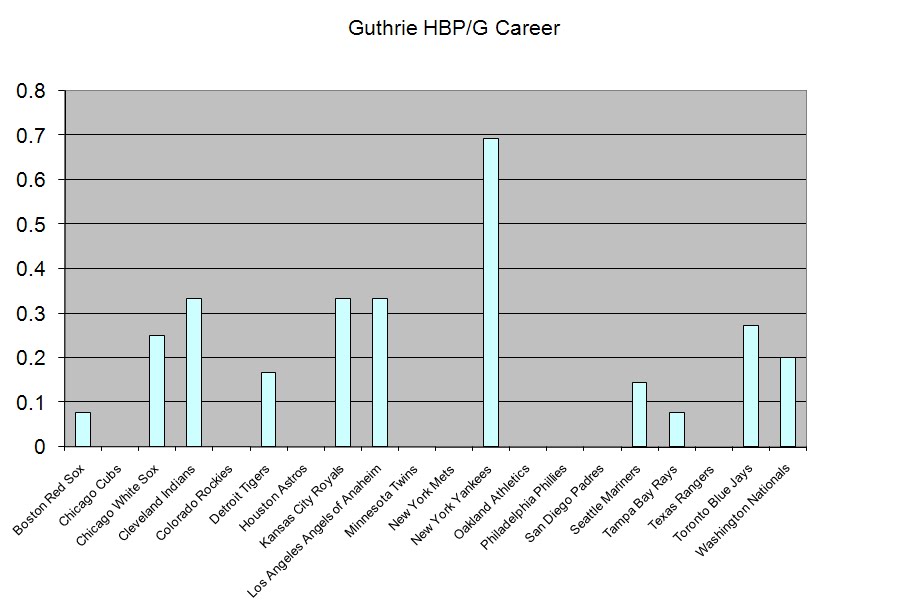
That tall line in the middle? Yep, that's the Yankees. Guthrie is hitting Yankees at twice the rate he hits any other single opponent. I don't know exactly what they did to make him mad, but he apparently didn't like it.
___________________________
Monday, April 26, 2010
The Bullpen
With good reason, the Orioles bullpen has been the target of much wailing and gnashing of teeth in the early going. So imagine my surprise today when I checked the pitching splits page at baseball-reference.com and saw that Orioles relievers (4.70) have a lower ERA than do Orioles starters (4.75)! How is this possible? There are two big reasons:
1) Brad Bergesen. He's made three starts, combining for 10.1 IP and a 12.19 ERA. Strip out those three starts and the rest of the O's starters have a 3.97 ERA over 99.2 IP, which is not too shabby at all.
2) Inherited runners. As of April 26, O's starters have passed off 16 baserunners to the bullpen. Nine of them have scored. The league average rate for inherited runners scored is 34% (across all situations; it is possible that O's starters have biased their inherited runners toward high run expectancy situations like second and third with no outs). If O's relievers could acheive that league-average percentage, the starters would have been charged with 4 or 5 fewer runs, bringing their collective ERA to 4.34 or 4.42. Control for Bergesen (who, ironically, has only had 1 of his 3 bequeathed runners score) and the top four O's starters have an ERA in the 3.60 range.
As for the more skill-dependent numbers, Orioles starters are performing better than their relief counterparts there, too:
K/BB ratio: 2.40 for O's starters, 1.85 for O's relievers
HR/9: 0.90 for O's starters, 1.17 for O's relievers
So, yes, the Orioles rotation has been much better than the bullpen, especially when you look at the numbers without Brad Bergesen. With the offense finally scoring a few runs this weekend, the bullpen needs to start pulling its weight to get the O's a few more wins.
_______________________________
Saturday, April 24, 2010
Roster Moves
Could the end of the Garrett Atkins era be near? The Orioles have recalled 1B/OF Rhyne Hughes from Norfolk today, but the move has not yet been made official so we don't know who will be leaving the 25-man roster. Speculation has initially focused on Alberto Castillo, Justin Turner or Julio Lugo, and each makes some sense. Castillo is the last man up in a larger-than usual bullpen (and I assume he can be optioned), Turner can be optioned, and Lugo is... well, Julio Lugo. But I'll suggest three other candidates:
1) Garrett Atkins - He's awful. In 60 plate appearances, he's walked twice and struck out 12 times. Plus, Hughes plays his position. He gets my vote.
2) Jason Berken - Berken has actually thrown well, but he, too, can be optioned. The O's may not need/want an extra long man right now.
3) Will Ohman - Again, the O's have an extra pitcher in the bullpen right now, and Ohman can't seem to throw strikes. Which, of course, he couldn't do last year, either. If he's not the guy today, he'd be my choice to go when the O's make a move for a 5th starter next week.
The moral of the story? It's probably not a good sign if your team is making a roster move and there are six legitimate candidates to be optioned or released.
_______________________________
Monday, April 19, 2010
The Orioles
Joe Posnanski is one of the best sportswriters around today:
The first Orioles game I ever attended was in 1990 at Memorial Stadium. It’s one of my favorite ever baseball experiences. The Orioles were already lousy then, but there was still the whiff of the great Baltimore teams in the air — Cal Ripken was at shortstop every game, Frank Robinson was managing the team, and you could park in front of somebody’s house (for a small fee) and walk through a neighborhood to get to the ballpark.
Baltimore represented just about everything I knew that was good about baseball — growing up in Cleveland, where the team constantly did everything wrong, the Orioles were like a team from another planet. From 1970-85, they had the best record in baseball. They pitched great, and they played great defense, and they hit the three-run homer, and they ran the bases beautifully. The biggest dream I could come up with as a young journalist — this is absolutely true — was to be a sports columnist for the Baltimore Sun. The Orioles, I know, were the big reason for that.
A few years later, I saw the Orioles play at Camden Yards. And it was beautiful … but different. I loved the park. I thought it was spectacular, and I found it amazing that such a new place could feel old, could feel like a part of Baltimore baseball tradition. The Orioles were pretty good then too; the ballpark was a money-printing machine and those were the years when they tried to match payrolls with the New York Yankees. They reached the championship series in 1996 and ‘97. But the Orioles could not sustain it.
This year, they drew fewer than 10,000 fans for just their fourth home game of the season — a 5-1 loss to Tampa. They were about 14,000 the next game and just a few more than 10,000 the following. The Orioles lost both of those too. You can’t blame the fans, not after 12 consecutive losing seasons, not with the team stuck in a division with the Yankees and the Red Sox and even the Tampa Bay Rays (who play, God bless ‘em, quite a lot like those classic Orioles teams used to play). No, you can’t blame anyone, but it’s sad to watch a great baseball town lose heart.______________________________
Subscribe to:
Posts (Atom)